
Stewart VINELink Custody Coverage
Georgia VINE and VINELink provide a one-person custody check and notification layer. They are not a Stewart County release list. Agency participation controls which records appear and how long a released result remains visible. Begin at the Georgia VINELink page, then search for the named person.
Stewart County contains county, state, and ICE custody. A Sheriff's Office release belongs to the county record. A GDC release belongs to state corrections. Stewart Detention Center is an ICE facility. Federal prison records belong to BOP. VINELink does not merge those systems, so confirm with the agency named in the result.
The official state entry screen appears below.

Use it to reach the specific-person search, not to browse all releases.
Search Stewart Inmates on VINELink
The Georgia person search accepts a name or offender ID when available. Use facility, age or birth details, offender number, and location to separate similar names.
- Open Georgia VINELink and choose person search.
- Enter the full name or known offender ID.
- Compare identity details and the custody agency.
- Open the matching record and read status and location.
- Confirm a release or transfer with that agency.
A blank result may mean a different spelling, a nonparticipating agency, movement to another system, or record retention after release. Retry a careful variation, then use the sheriff, GDC, ICE, or BOP route that fits the last custody.
The person-search screen shown below illustrates this record-first process.
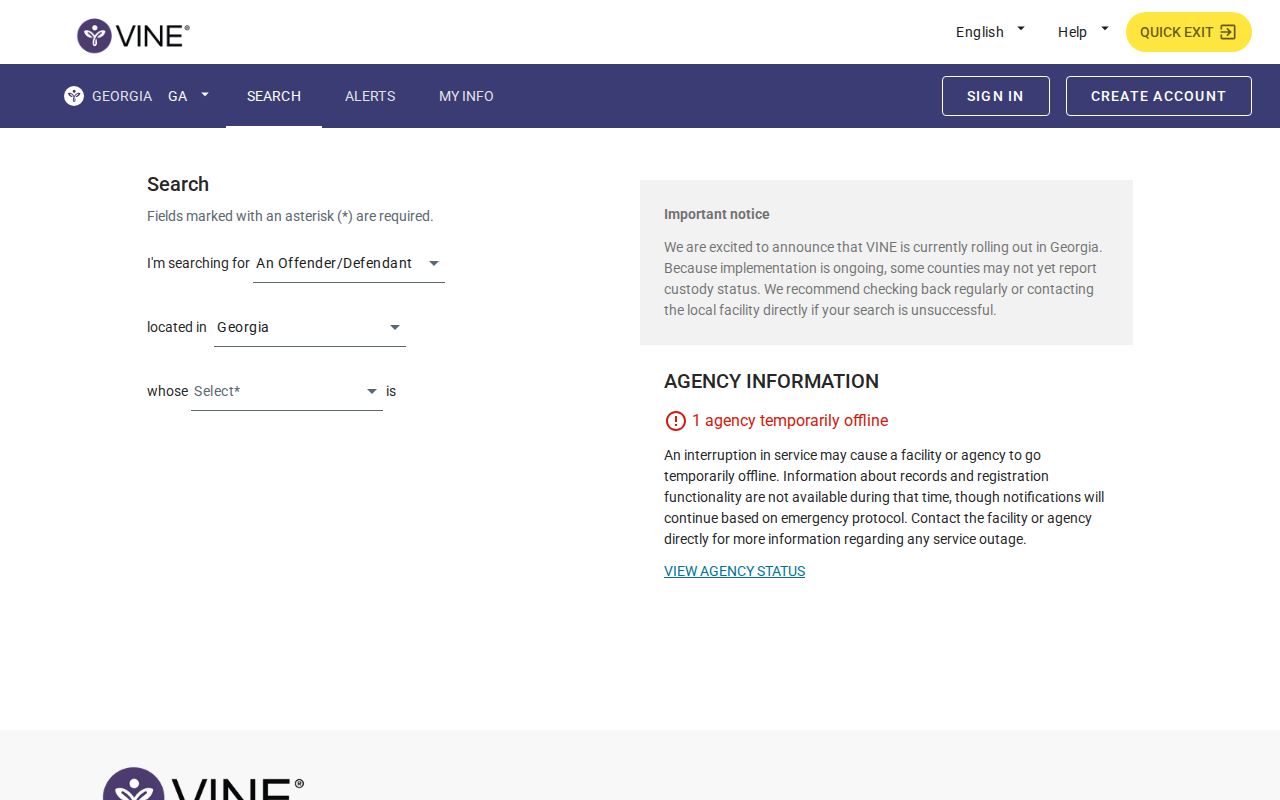
It searches one named record and does not produce a complete county release feed.
Stewart VINELink Release Fields
Fields vary by agency feed. A record may show name, offender ID, age or birth detail, custody status, agency, facility, and event date. A released record may show out-of-custody status or may disappear after retention ends.
| Field | Use |
|---|---|
| Name and ID | Match the person |
| Agency or facility | Identify the custody system |
| Status | Read held, released, or transferred wording |
| Event date | Compare with official records |
| Alert option | Register on the matching record |
Transfer can mean continued custody elsewhere. A current-custody status means the feed still reports confinement. An out-of-custody result is useful, but the agency record is needed for exact time, reason, and destination.
Register Stewart Release Alerts
When a matching record supports notifications, VINELink may offer phone, email, text, TTY, or in-app notice. Methods differ by agency. Registration must be tied to the right person.
- Open the matched custody record.
- Select notification or registration.
- Choose an offered contact method and event.
- Create the required PIN for phone notice.
- Complete confirmation and save the details.
- Verify with the custody agency when alerted.
The PIN confirms receipt and may stop repeat calls. It is not an offender ID. Georgia VINE support is listed at 1-833-216-6670. The VINELink mobile app offers another delivery route, but it does not expand an agency's coverage.
Stewart VINELink Release Limits
Alerts depend on agency data and may lag the real event. VINELink is not the official Stewart County release record, a court disposition, GDC sentence computation, an ICE decision, or a BOP record.
For county jail, call the Sheriff's Office at 229-838-4311 during weekday business hours or request the release record. For state prison, use GDC and check actual release date. For Stewart Detention Center, use ICE. For federal prison, use BOP. The Stewart County released inmate search path helps reconcile the sources.
Stewart County does not publish a separate SAVIN page or public jail release feed. That local gap makes VINELink useful, but it also makes source confirmation vital. A missing name does not prove release, and leaving the county jail may mean transfer to GDC, ICE, another county, or federal custody.
For a county record, request release date and time, release reason, booking number, and transfer destination. For state prison, compare the alert with GDC current status and actual release date. If a result names Stewart Detention Center, use the ICE facility channel because it is not the county jail. A federal result belongs in the BOP locator.
Delivery can fail even when custody changes. A phone may block an automated call, an email may enter a spam folder, or an old number may remain registered. Keep the confirmation details, update contact information, and never assume silence means custody stayed the same.
Stewart's One-Person Alert Layer
Georgia VINELink is best used to monitor one known custody record. Search results should be reconciled by name, ID, age or birth details, facility, and last known agency. If the alert says released while an official record says active, ask the custody agency to resolve the conflict.
This matters more in Stewart County because a Lumpkin custody question can concern the county jail or the separate ICE detention center. Choose the system first. Then use VINELink only where the participating record supports it.
The sheriff channel is the start for local bond, time-served, dismissal, or court-order release. GDC is the start after transfer to state prison. VINELink can sit beside either route if the record participates, but it cannot turn one agency's update into another agency's official record.
Identity checks matter as much as status checks. Compare full name with age or birth data, offender ID, facility, and known case details. If two records look similar, do not register until the correct person is clear. An alert on the wrong record can cause needless concern.
The exact registration screen may vary. Follow the options on the selected record, save confirmation, and contact Georgia VINE support for service access. The holding agency still answers the custody question.
Note: VINELink may report a custody change, but only the originating office can explain the legal type and destination of release.
Confirm Stewart Alerts in Writing
A release notification can help with personal safety planning, reconnecting with someone, or following a known court and custody event. Register only contact methods the user controls. If repeat calls continue after confirmation, use the saved PIN and service support. For urgent safety needs, the alert service is not a substitute for emergency services or direct agency contact.
Records can change after an alert. A release may be followed by parole or probation, and a transfer may create a new record in the receiving system. Recheck the source when the facility changes. The county sheriff cannot confirm an ICE-only event, and ICE cannot explain a GDC sentence date.
When written proof is needed, request it from the creator. Stewart County sheriff records document county booking and release. GDC can verify state-prison information. Court records explain bond, sentence, or disposition. The notification is a timely signal, while those records provide the lasting account.
Route Stewart Release Confirmation
The Stewart County Sheriff's Office is the correct source for a local booking and release. Ask whether the person left county custody, the recorded time and reason, and whether another agency received the person. A transfer destination matters because disappearance from local custody can look like release in a notification service while confinement continues.
For GDC, read current status with actual and maximum release fields. The public offender record may remain searchable after state release. GDC warns that its public information should be verified in writing with Inmate Records and Information before it is assumed complete. VINELink adds notice, but it does not override that warning.
For Stewart Detention Center, follow ICE's detainee locator and facility contact. The center sits in Lumpkin but is not the county jail. BOP covers sentenced federal inmates, while U.S. Marshals custody may require court and holding-facility records. VINELink should not be used to fill a gap in either federal route.
Write down the alert time, displayed agency, status wording, and event date. Then compare the official source. This small audit trail helps explain whether a later difference came from data lag, a transfer, a corrected identity match, or a new custody event.