
Stewart Parole Versus Probation
Parole is conditional release from a Georgia state-prison sentence. The Georgia State Board of Pardons and Paroles makes the release decision, and the Georgia Department of Community Supervision, or DCS, handles supervision in the community. Probation is imposed by a court. It may follow jail time, form part of a split sentence, or begin with no prison term. Felony probation generally falls under DCS, while misdemeanor arrangements must be checked with the sentencing court. Neither term means that a person was released from the Stewart County jail on a specific date.
| Point | Parole | Probation |
|---|---|---|
| Who orders it | State Parole Board after GDC custody | Sentencing court |
| Custody link | Release from state prison | May follow jail or avoid prison |
| Main verification | Parolee search, GDC record, DCS | Court order and DCS for felony cases |
| How it ends | Discharge or sentence completion | Court/DCS completion or discharge |
A Stewart County booking record can state that someone left jail, yet the supervision terms usually sit in a sentence, probation order, or parole file. Match the name, case number, conviction county, and GDC identification number when available. That avoids joining two people with similar names or treating a transfer to prison as community release.
- Parole
- Conditional community release before a state-prison sentence reaches its maximum date.
- Probation
- Court-ordered supervision served in the community.
- TPM
- A tentative parole month, not a final release date.
- Absconder
- A person alleged to have stopped reporting or left supervision without approval.
- Discharge
- The formal end of a supervision term.
Verify Stewart Post-Release Supervision
Start with the source that created the status. A released county detainee may have probation in a Stewart court order. A person leaving GDC may have a parole record. The Georgia Parole Board provides the TPM lookup and parolee database, while the DCS field-office locator identifies the office that serves the supervision address.
- Check the Stewart court case for the sentence, probation term, and case number.
- For a state-prison case, compare the GDC status and actual release date with the same identity and conviction county.
- Use the Parole Board parolee search for a person already released on parole. Use TPM only for a person still awaiting a parole decision.
- Locate the assigned DCS office. Stewart County felony supervision is routed through Americus.
- Ask the court, Board, or DCS to confirm any unclear active, discharged, warrant, or violation notation.
The Board says parole-eligible people in GDC custody are considered automatically. They do not file an application. For non-life cases, the Board can set a TPM or deny parole, then conduct final review near that month. A TPM may move or be canceled because of conduct or an unmet program condition. It should never be reported as proof that release occurred.
Stewart Supervision Runs Through Americus
Stewart County felony supervision is not routed to a DCS field office in Lumpkin. The DCS Americus Field Office serves Stewart along with Lee, Macon, Schley, Sumter, Webster, and the Southwestern Circuit. That regional service map is important after a prison or felony-probation release. The place of conviction and the place of supervision may differ, and an approved move can change the reporting office.
108 E Lamar St
Americus, GA 31709
Phone: 229-931-2537
Fax: 478-575-5074
Monday-Friday, 8:00 a.m.-4:30 p.m.
The official Americus listing shown below is the source for Stewart County service and office details.
View the DCS Americus Field Office listing.
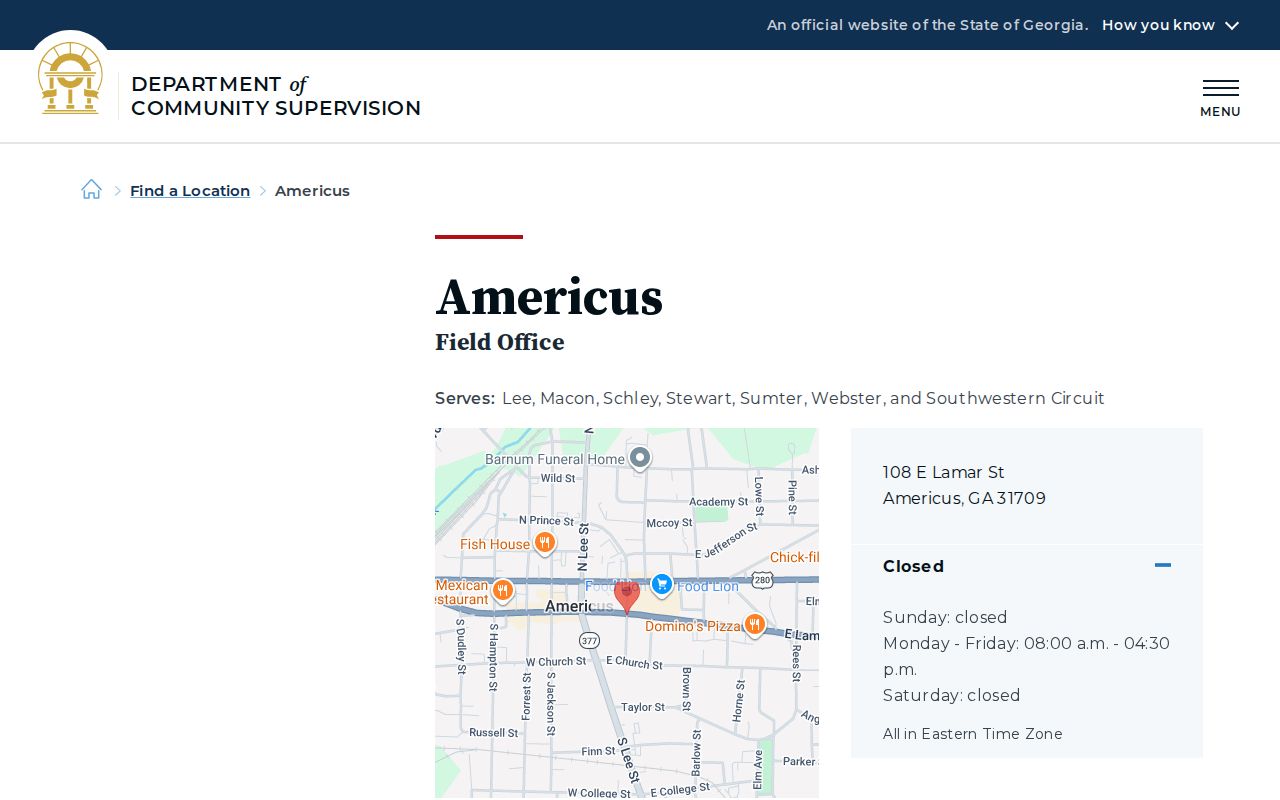
The office listing helps route a valid supervision question, but it does not replace the sentence or prove a county jail release.
Stewart Supervision Violations
Conditions vary by sentence and parole decision. Common terms can require reporting, approved residence, payment obligations, treatment, testing, travel approval, or compliance with special court terms. Only the order and supervising agency establish the actual rules. A violation allegation may lead to a warrant, arrest, or revocation proceeding, but it does not by itself show where the person is held.
An absconder label generally means the agency alleges that the person stopped reporting or left supervision without approval. Confirm that status with DCS, the Parole Board, the issuing court, or the sheriff warrant channel. Georgia VINELink may report a later custody change for a participating agency, but it is not a supervision docket. A rumor, old social post, or stale custody result is not enough.
Parole Board meeting notices and press releases show public Board business. They are not individual parole hearing dockets. Ordinary parole choices are generally made through file review, and the person's TPM or parole record is the better individual source.
Stewart Supervision Discharge Records
Supervision ends through discharge, sentence completion, a court order, or another formal agency action. Discharge means the agency has closed the active supervision term. It does not erase the conviction, booking, court docket, or prison record. Likewise, release from jail does not end a probation term unless the sentence or later order says so.
For proof, request the final order or discharge record from the office that created it. The Stewart court is the best source for a probation sentence and later court action. DCS can address felony supervision status. The Parole Board is the source for parole decisions, and GDC records can show the state-prison actual release date. The broader custody and release-record path is described on the Stewart County released inmates search.
Georgia record restriction can limit public access to some criminal-history information, but it is a different process from finishing supervision. A discharged term should not be described as sealed or erased unless an official order supports that result.
When records disagree, compare the date each office last updated its file. A court order may establish probation before DCS intake is visible. A parolee search may show community status after GDC changes the prison record to inactive. The safest sequence is the sentencing order, GDC release field when state custody was involved, Parole Board decision, and DCS assignment. Each source has a distinct job. Stewart County misdemeanor supervision requires extra care because the Americus listing covers felony supervision. The sentencing court should identify the misdemeanor provider and actual terms.
Stewart State Release Card Funds
A GDC release has a funds process that does not apply to a Stewart County jail release. According to GDC Georgia Release Card information, money left on a state prisoner's account is moved to a release card after release. The person activates a PIN by calling 866-777-5729. This detail belongs to the state-prison branch only.
The card does not establish parole or probation. It concerns funds held by GDC. Supervision still must be checked through the Parole Board, DCS, and the sentence. Keeping these records separate prevents a routine release-funds step from being mistaken for proof of a specific supervision status.
A person leaving GDC may need both the release-funds instructions and a DCS reporting plan. Those tasks run in parallel. The card handles money left on the state account. The parole certificate, probation order, or DCS instructions govern reporting and conditions. A card question goes to GDC, while a supervision question belongs with the Board or DCS.
Note: County jail property and money questions should go to the Stewart County Sheriff's Office, not the GDC release-card channel.
Check Stewart Supervision Sources
A final verification should answer four points: which court imposed the sentence, whether GDC custody occurred, whether the Parole Board authorized release, and which DCS office holds the supervision file. A single search result rarely answers all four. Use the case number and GDC ID to connect records when available.
If an office cannot confirm a status by phone, ask what written record is available and which office created it. A sentence or discharge order is stronger than an old directory entry. Keep the date of the response because supervision can end, transfer, or return to active review after a violation proceeding.