
Stewart Projected Versus Actual Release
A projected release date estimates when a sentenced person may leave custody. An actual release date records that a custody event ended. They are not interchangeable. A pretrial Stewart County detainee normally has no fixed release date because bond, dismissal, a plea, a hold, or a new court order can change custody at once. A sentenced county detainee follows the court order and jail credit. A state prisoner follows GDC sentence computation and any Parole Board action.
The date source must match the custody system. The Stewart County Sheriff's Office and court control local questions. GDC controls state-prison sentence records. The Parole Board controls parole decisions. ICE and BOP dates belong to separate federal systems.
Find Stewart Projected Release Dates
First identify the last custody agency. For a Georgia state prisoner, use the GDC Offender Search. Search exact name, GDC ID, or case number, then compare conviction county, offense, status, and sentence. For a local jail sentence, call the Stewart County Sheriff's Office at 229-838-4311 during weekday business hours and check the sentencing order.
- Confirm whether custody is county jail, GDC, ICE, or federal.
- Match name with birth details, ID, case number, and conviction county.
- For GDC, read current status, max possible release date, and actual release date separately.
- Check the Parole Board TPM tool if parole consideration applies.
- Ask the court or custody agency about holds, credits, or later orders.
- Recheck near the date and confirm actual release.
The Stewart County released inmate search provides the broader path when the person has already left custody. A missing live-roster entry does not prove release.
Georgia Credits Affect Stewart Releases
Georgia does not have one universal percentage rule for every sentence. O.C.G.A. § 42-5-101 lets GDC devise work incentive credits for eligible felony prison terms other than life. Credits may reflect academic or vocational gains, satisfactory work, and conduct. They are reported to the Parole Board and may advance a tentative parole date.
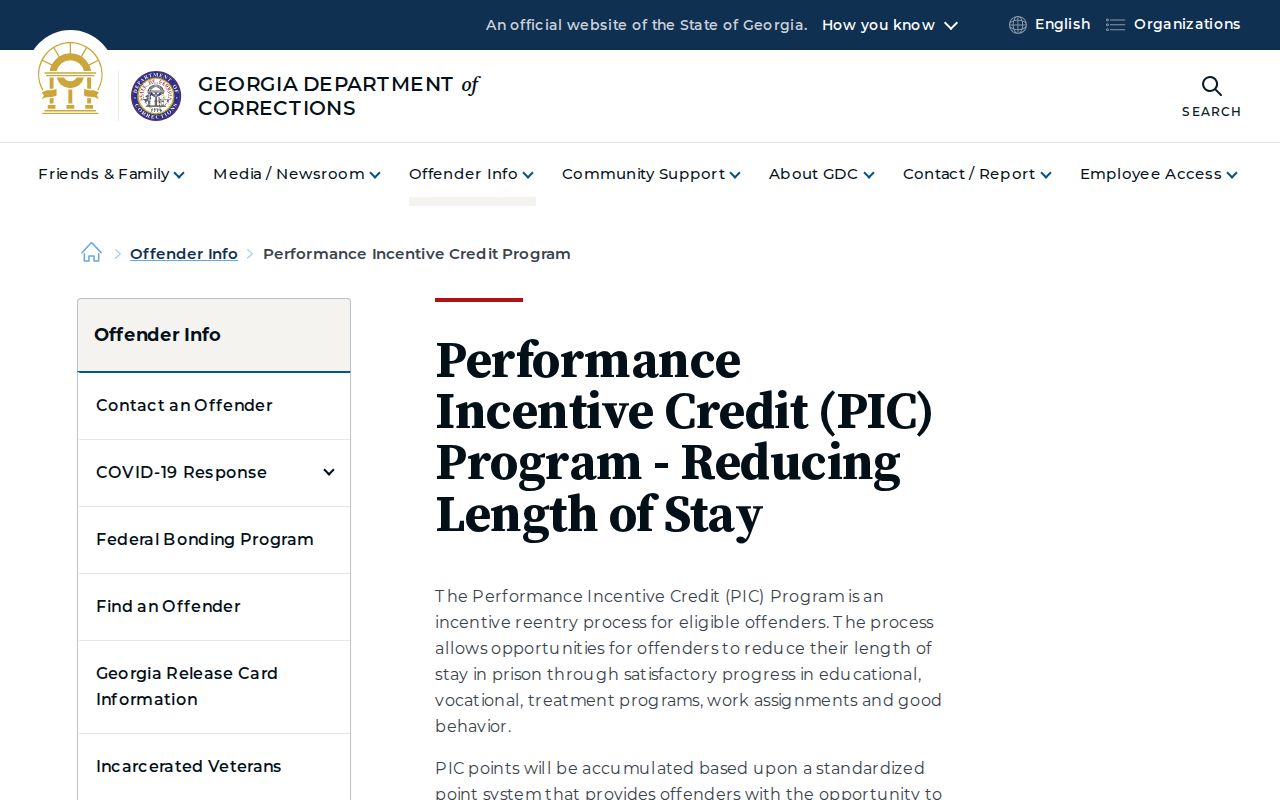
GDC's Performance Incentive Credit program states that eligible people can earn up to 12 points, potentially reducing TPM or MRD by one to twelve months. Exclusions include short sentences, life sentences, and offenses or mandatory terms that are not parole eligible. Conduct remains critical.
The official PIC page shown below explains the state-prison credit route.
These state credits do not compute a short Stewart County jail term. Sheriff records and the court order control that local date.
Serious violent felony rules in O.C.G.A. § 17-10-6.1 can restrict parole, earned time, and early release. Sentence type, mandatory minimums, recidivist rules, life-sentence rules, PIC, and parole eligibility all matter.
Why Stewart Release Dates Change
A projected date is a live computation. New legal or custody facts may move it forward, move it back, or prevent release to the community. The source should explain which factor changed.
| Factor | Possible effect |
|---|---|
| PIC or work credit | May advance an eligible state date |
| Discipline | May delay or cancel a TPM |
| Detainer or hold | May cause transfer instead of release |
| Court order | Can alter a county or state sentence |
| Parole decision | May set, deny, postpone, or cancel release |
| Computation correction | Can change a displayed GDC date |
GDC advises that suspected sentence-computation errors should be addressed through official records channels. A court docket may explain jail credit, amended sentence terms, or a new hold. Do not infer the cause from the changed number alone.
Confirm Stewart Release Dates
Near an expected date, recheck the official custody record. For GDC, look for actual release date and inactive or released status. GDC warns that public data may be incomplete and directs written verification to Inmate Records and Information, P.O. Box 1529, Forsyth, GA 31029. For the county jail, ask the Sheriff's Office whether the person left, when, why, and whether another agency received custody.
Georgia VINELink can send a custody-change alert for a participating record. The Stewart County VINELink inmate search explains alert registration. An alert is not the final record. Court disposition, sheriff release data, GDC actual date, or the receiving agency must confirm the outcome.
Note: Always distinguish release to the community from transfer to GDC, another jail, ICE, or federal custody.
Stewart MRD TPM Date Trap
Georgia uses three terms that answer three different questions. GDC defines Max Out or MRD as the maximum release date if the judge's sentence is fully served. The Parole Board's TPM is the month when final parole review is expected. Actual release date records the event after it occurs.
The GDC terminology page is the source for MRD and Max Out, while the Parole Board TPM page says a TPM is not final. A Stewart County jail release date is a fourth, local record and must not be substituted for any of these state fields.
Current status supplies context. An active GDC record with a future MRD does not show completed release. An inactive record with an actual date documents a past GDC event, though another hold or supervision term may apply. A TPM shows review timing and can be postponed, canceled, or followed by a later decision.
County jail computation is narrower. Bond can permit release when conditions are met. Dismissal can end custody if no other hold exists. A short sentence may depend on jail credit and the written order. The sheriff and court must reconcile those facts.
The GDC terminology screen below helps keep the date labels distinct.
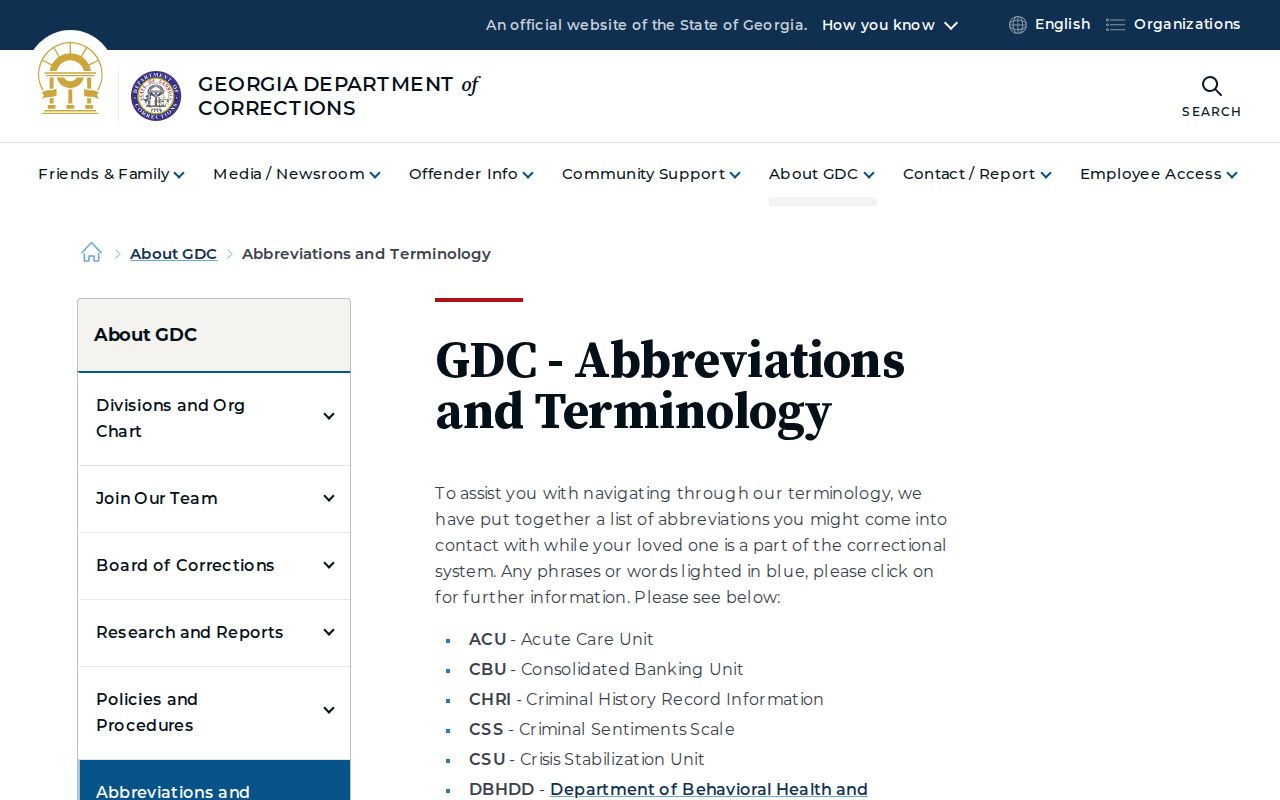
Read the label, agency, and current status together before describing when someone will leave custody.
A detainer is another agency's request to hold or transfer a person. Reaching the end of one sentence may lead to another jail, state, federal, or immigration system. Ask whether a hold exists and which agency will receive custody.
Parole review differs from expiration. The Board may set a TPM, deny parole, or conduct final review. Misconduct or an unmet program condition can change the result. Life and serious violent felony sentences follow special rules, so a general calculator cannot supply a sound Stewart County date.
After the expected day passes, look for actual release or obtain the jail release record. That final check distinguishes a completed event from a projection that moved and helps match later supervision or transfer records.
Audit Stewart Projected Dates
A projected date should be recorded with its source and lookup date. GDC may update a sentence computation, the Board may revise a parole decision, or a court may enter a later order. Saving the exact field label prevents an old projection from becoming a claim about present custody.
For a Stewart County case moved from jail to GDC, keep both events. The county transfer date marks departure from local custody. It is not the eventual prison release date. The later GDC actual release field documents the state event, while DCS or the Parole Board may show supervision afterward.
If no date appears, do not estimate from sentence length alone. Jail credit, concurrent or consecutive terms, mandatory minimums, holds, and agency rules can change the result. Ask the responsible records office for its current calculation and the basis for an unexplained change.
Match Stewart Dates to Custody
A Stewart County court case can create several dates without creating one reliable release forecast. The sentence date starts the written order. Jail credit may account for prior confinement. A transfer date marks movement to GDC. MRD marks the maximum state sentence date, and TPM marks parole review timing. Only an actual release field or local release record confirms the event.
Use conviction county and case number to connect the GDC result to the Stewart court file. Similar names are not enough. Where the court order and public GDC display seem inconsistent, ask the responsible records office about sentence computation rather than choosing the earlier date.
County pretrial custody is even less predictable. Bond may be set but not satisfied. Another hold may block departure. A new court order may release the person the same day. No state-prison credit formula can replace a sheriff and court check for those local facts.
Once release occurs, look for the next status. Parole or felony probation may route to DCS Americus. A detainer may route to another custody system. The final destination explains why reaching one projected date did not always mean unrestricted return to the community.